
Wayang Golek, living cultural heritage
When you delve into the classical Javanese puppetry, you quickly find yourself in a captivating maze of stories, styles, and theatrical forms. Attending a performance or identifying the correct name for a puppet can be quite a challenge. Some puppets have multiple names or are used for various characters. The presence of tourist puppets, which may not always adhere strictly to traditional artistic rules, adds an additional layer of complexity. And let's not even mention the regional stylistic differences, shall we?
Code cracked
Complicated? Perhaps, but the 'code' can be cracked. An excellent tool for that is the Dutch book 'Wayang Golek, The fascinating world of classical West Javanese puppetry' (‘Wayang Golek, De fascinerende wereld van het klassieke West-Javaanse poppenspel')by Peter Buurman that was published in 1980. Buurman's great achievement is that he was the first to successfully map and make accessible the Wayang typology to a wide audience. Through his over 200 original drawings (see below) of various types of hands, faces, and headdresses, Buurman takes us on a journey of discovery.
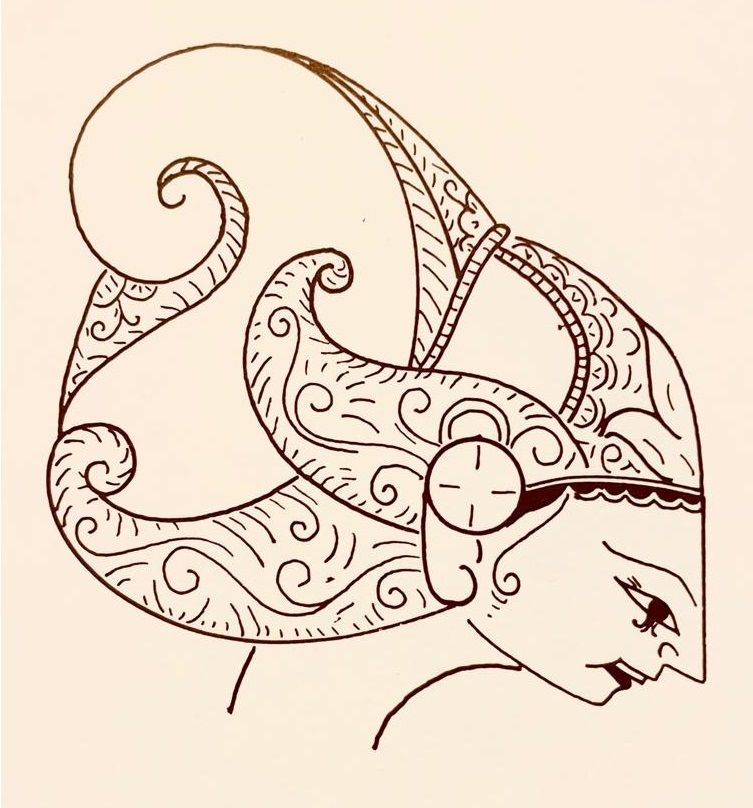
Pop A26. Yudistira
Face: white. Headdress: gelung keling, usually with two sumpings, sometimes with one. No jamang. No ornaments around arms and wrists. This puppet appears in all sets and is hardly variable
Not interchangeable with other characters.
Translated excerpt from Wayang Golek by Peter Buurman (p. 85)
[Book for sale in the webshop]

Living heritage
Buurman's typology still provides a reference point for many enthusiasts and collectors today. Yet, since the publication of Buurman's book, the carving style has further evolved, with respect for the centuries-old tradition. While puppets from over 100 years ago were often stylized according to the essentials, today, these 'basic forms' are further elaborated with an even greater eye for detail. Additional curls and ornaments, even more striking colors, extra shiny glass beads... the puppeteers (Dalangs) go to great lengths to keep the interest in this traditional art form alive and regularly update the puppets they use during performances.

Yudistira, 1930

Yudistira, 1950

Yudistira, 2023
To enable more details, the new puppets are often a bit larger which also improves visibility. It's not surprising, then, that the (often updated) stories continue to mobilize entire communities today, gathering to enjoy a performance accompanied by the enchanting sounds of a gamelan orchestra.
House of Wayang aims to contribute to the preservation of this marvelous cultural heritage.. In Indonesia, by assisting puppeteers in finding the necessary resources to create new puppets and musical instruments. And internationally, by sharing as much information as possible about each puppet with the help of friendly collectors and Dalangs. Do you have questions about a specific puppet or character? Be sure to contact us.
